Intermittent Coolant Leak Pressure Test Uk
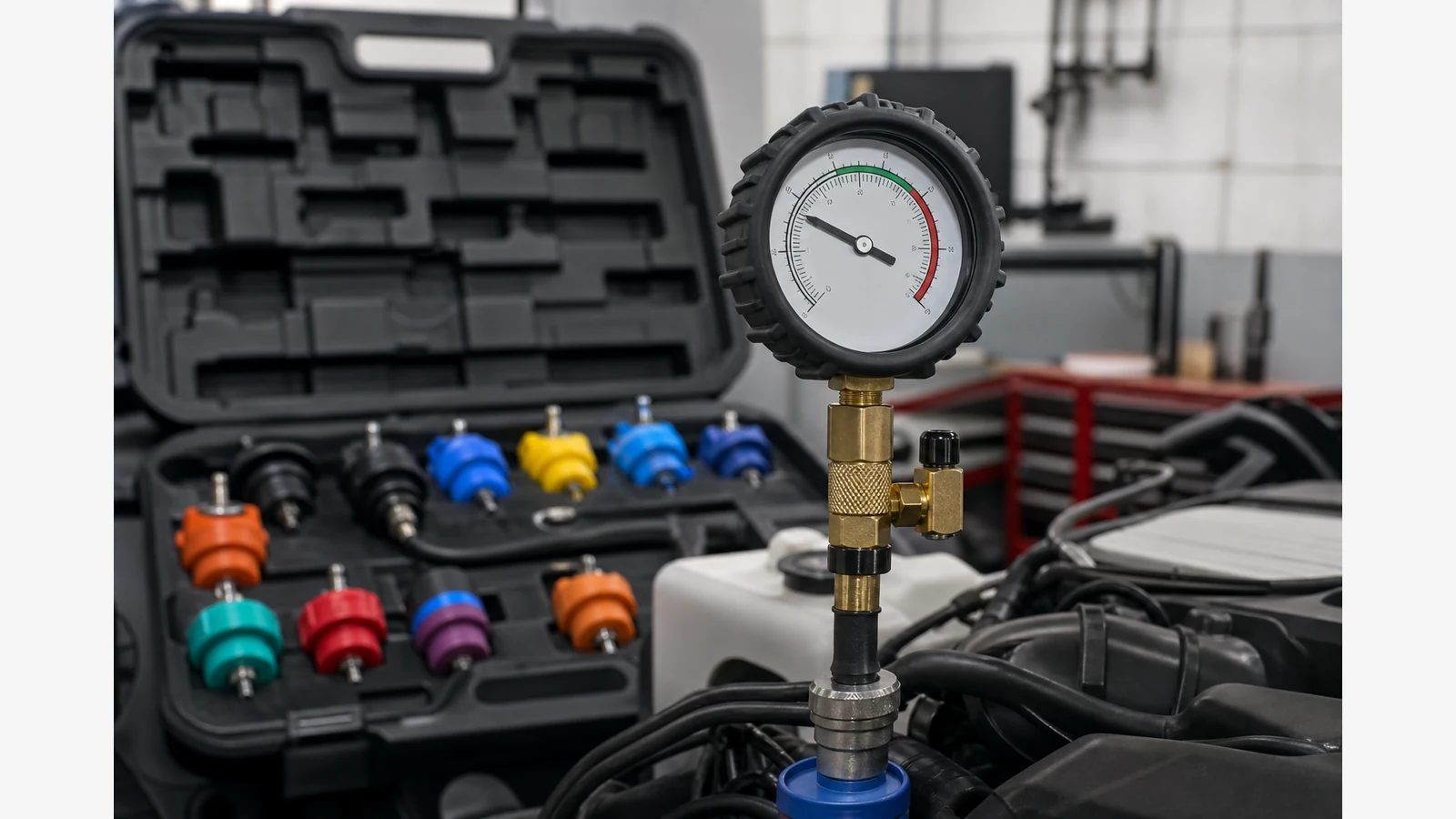
Intermittent coolant loss with no cold puddle is often a heat-only leak: the joint or crack only opens when the system is hot and pressurised. A UK garage pressure-hold workflow finds many of those leaks cold by recreating operating pressure with a hand pump, then watching the gauge for a timed hold instead of guessing on the ramp.
Why heat-only leaks waste ramp time
Many leaks only appear when the system is hot and under pressure. Pressurising a cold system lets you reproduce that pressure without scalding coolant, then hunt for spray or dribble while the gauge tells you whether the circuit is sealed. Haynes Manuals UK on finding coolant leaks with a pressure tester emphasises that a falling gauge with visible spray shows an external leak path.
Five-to-ten minute pressure-hold workflow
- Cool the engine fully and protect yourself from residual heat.
- Match the correct adapter to the expansion/header tank or radiator neck.
- Pump to the rated test pressure for the vehicle/cap — UK tool instructions commonly work around 10–15 psi / about 1 bar, and warn not to exceed roughly 15–20 psi.
- Hold for at least one minute (OEM kit minimums); extending to five–ten minutes helps catch slow weeps without inventing laboratory accuracy.
- If the pointer falls, hunt visually for spray/dribble at hoses, clamps, radiator, pump weep hole, tank seams and heater pipes.
- If the gauge is steady, document a sealed cold hold and plan a hot road-check or further diagnostics as needed.
Sealey VS0011 pressure-test instructions (PDF) describe a short hold with a falling pointer as a leak indication, and they call for a retest after repair. Laser Tools cooling-system tester instructions (PDF) similarly start from a cool system, pump around 10–15 psi, and treat a steady gauge as sealed.
If the gauge falls with no external leak
Document the pressure loss, check the pressure cap if your kit supports it, and treat internal leak suspicion carefully. A falling gauge without visible coolant is not automatic proof of head-gasket failure — escalate with the right combustion/chemical tests rather than guessing. For smell-led driveway triage, see coolant smell but no puddle. After any repair, make a cold retest part of the SOP — the pressure-test checklist after water pump replacement covers post-open-circuit verification.
Adapter fit and workshop kit notes
For expansion-neck technique detail, follow the expansion-tank pressure testing step by step guide. If your bay needs a multi-adapter hand-pump kit for daily intermittent leak work, review the CoolTest Pro 28-piece kit only when that tooling gap is real — the workflow itself does not require a purchase.